Translate

Wednesday, 2 October 2019

Made in Greenwich - a treasure-trove of local art and crafts


London’s fascinating and historic district of Greenwich has a brand new attraction that showcases the talents of local artists and craftspeople. Made in Greenwich is a shop/community hub just around the corner from the Docklands Light Railway Cutty Sark station, and is packed with locally-made and exclusive goods that reflect the area.
You can find anything from a piece of beautiful jewellery to a colourful scarf, unusual lampshade, eye-catching cushion, flattering headpiece or even a macramé plant hanger.
There are beauty products, candles, pictures and bunting, while foodies can browse the local produce, safe in the knowledge that no air miles have been involved in their creation. And for those seeking a little souvenir of their visit, there are Made in Greenwich mugs and a range of beautiful cards.
The shop is the brainchild of GCDA – the Greenwich Co-Operative Development Agency – which aims to support people and enterprises in the area. The stock changes all the time. The shop’s curator, designer and writer Mary Jane Baxter, has a creative background that includes two craft books and being a judge on the popular BBCs daytime series Paul Martin’s Handmade Revolution, so is always on the lookout for new talent.
She has created a delightful interior that makes the most of upcycled material including surplus paint from The Forest Recycling Project and wallpaper remnants used in collages (donated by Pickwick Papers in Greenwich) to cover the doors. At the rear is a creative space that can be hired for workshops, pop-up events or training (above).
Some of the goods are created by Mary Jane herself, including these imaginative artificial flowers that feature re-used knitting needles and old maps. There will be a pre-Christmas celebration in December, but if you are already on the lookout for festive gifts, my advice is to get along there now, before the crowds descend.
Made in Greenwich, 324 Creek Rd, SE10 9SW. Open Thursday to Saturday 1000 – 1700, Sunday 1100 – 1700
Ph: 020 8269 4880

Tuesday, 1 October 2019

William Blake exhibition - Tate Britain


Portrait of William Blake 1802.Collection Robert N. Essick
When William Blake mounted his one and only independent exhibition of his paintings in 1809, in a room above his family’s hosiery shop in Soho, the critic Robert Hunt (brother of the more famous Leigh) wrote that the works were “the ebullitions of a distempered brain” and that Blake himself was “an unfortunate lunatic”. Not a single one was sold.
What a contrast with this new, sweeping show at Tate Britain which takes more than 300 of his images, lent from all over the world, and illustrates how he was a product of his tumultuous times, surrounded by revolution, war and radical politics. His artistic career began fairly conventionally, with drawing lessons, an apprenticeship as an engraver and enrolment as a student at the Royal Academy of Arts, where he was encouraged to copy antique sculptures and seek inspiration from Renaissance artists such as Michaelangelo and Raphael. But as the exhibition shows he soon rejected the rigid ideas being taught at the time and pursued a more personal vision.
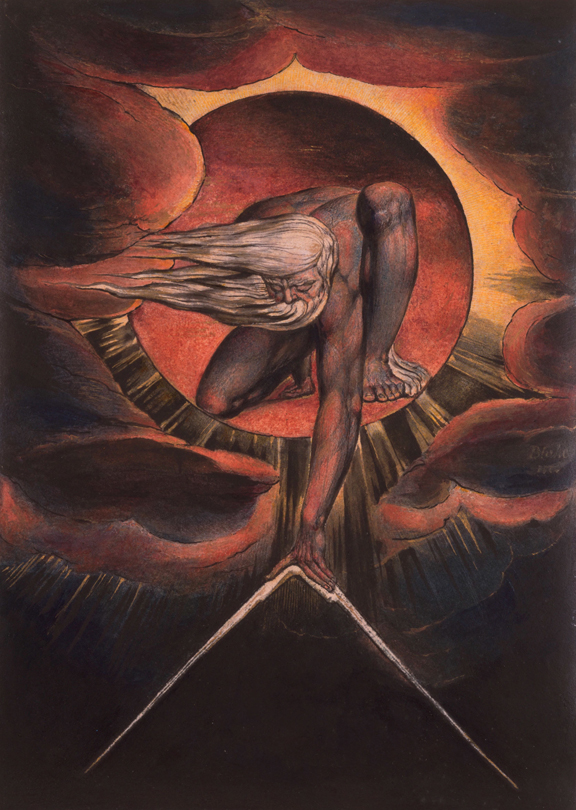
William Blake Albion Rose c. 1793 Courtesy of the Huntington Art Collections
 It opens with his Albion Rose, c 1793, a visualisation of the founding of Britain, created in contrast to the commercialisation and austerity of the times, then follows his career through to his death in 1827, at the age of 69. He never earned much, but his engraving provided a basic income, and around 1788 he invented a new form of printmaking, ‘relief etching’. His exact methods are still unknown, but the process allowed him to print in colour and combine texts and images. He created a succession of visionary books which took in the most pressing moral and political questions of the day.  The exhibition curators point out that luckily few people saw these books, and the symbolism in them was obscure – if they’d come to the notice of the authorities, Blake might have been arrested because of their radical sentiments.
Some of these volumes – including Songs of Innocence and Experience – are displayed in cases, enabling visitors to get a close look at the intricate detail surrounding what are now among his best-known works, including The Tyger (above) and its sister poem, The Lamb. Throughout his life Blake depended on the support of family and friends, including his wife, Catherine, who hand-coloured some of the engravings. He had an ocasionally fractious relationship with his few loyal patrons. They admired his unconventional character and independent spirit but he resented being their employee and the advice they sometimes offered. The gallery shows the range of his work, including watercolour illustrations of the Bible, Shakespeare and John Milton.
William Blake The Ghost of a Flea c.1819 Private Collection
Everywhere you are confronted with images which sprang from his vivid imagination – who else could have conjured up the Ghost of a Flea (inspired by a séance-induced vision) or Nebuchadnezzar, crawling along with terrified eyes? 

There’s also a recreation of that first exhibition (above), which was in a small, bare, dimly lit room. Blake, understandably, was bitterly disappointed at its failure, and withdrew from the public gaze for several years. But in 1818, encouraged by some younger and more business-savvy artists, he experienced a late burst of creativity. This produced his illustrations for Pilgrim’s Progress and the poem that has become almost a national anthem, Jerusalem.
William Blake Jerusalem, plate 28,  1820 Yale Center for British Art (New Haven, USA)
He died while working on his final commission, illustrations for Dante’s Inferno, with Catherine, as ever, at his side. In 1957 a memorial to Blake and his wife was erected in Westminster Abbey.
William Blake Catherine Blake 1805 Tate. Bequeathed by Miss Alice G.E. Carthew 1940
The exhibition is being described as rediscovering Blake for the 21st century, and a once-in-a-generation event. (The last major showing of his works was at Tate Britain in 2000.) It may be another 20 years before his work is again displayed in such a comprehensive way.
William Blake Newton 1795c.- 1805 Tate

William Blake is at Tate Britain until February 2, 2020. £18 (concessions available).

Wednesday, 31 July 2019

Hambledon - the cradle of cricket


With cricket attracting so much attention this summer, it seemed right to visit the spiritual home of the game – Hambledon, in Hampshire, set in the South Downs National Park and surrounded by sweeping farmland and leafy woods. A form of cricket had been played on the Downs for many years, but in 1750 the Hambledon Cricket Club was founded and took responsibility for developing the laws of modern-day cricket, including the regulation of bat width and the addition of a third stump.
The game was initially played on the wide open space of Broadhalfpenny Down, originally the village's sheep common; we paused there to photograph the memorial stone that marks the spot. Meetings were held in the Bat and Ball pub opposite, where we had lunch, watching the many birds in the garden, including a woodpecker.
The historic building is packed with memorabilia, and worth exploring. I was intrigued by this  original bat that now graces a wall – it looks more like a hockey stick.
For aficionados, there's a set of rules printed in 1755.
A very human touch caught my eye too: in 1756 a yellow and white spaniel, named Rover, went missing during a cricket match at Broadhalfpenny Down. He belonged to the local vicar, the Rev. Mr Keats, who must have been very upset as he posted a notice offering a reward for his return of five shillings, then two days' wages for a skilled tradesman!
There's much about the pub’s landlord at the time, Richard Nyren, who was also ran the club. He went down in history for leading a team that played an All England XI on 51 occasions in the latter part of the18th c and defeated them 29 times. It's recorded he was left-handed both as a batsman and bowler. Interest in the sport grew and in 1787 the development of the game passed to a more central venue, the newly founded MCC (Marylebone Cricket Club) in London. Hambledon reverted to a village club, though its success has continued: its senior team reached the 1989 final of the national village knockout cup at Lord's. Hambledon Cricket Club is now based at Ridge Meadow, an idyllic cricket ground set amongst some of Hampshire’s prettiest countryside just to the west of Broadhalfpenny Down.

Thursday, 13 June 2019

Gardeners' World Live at the NEC

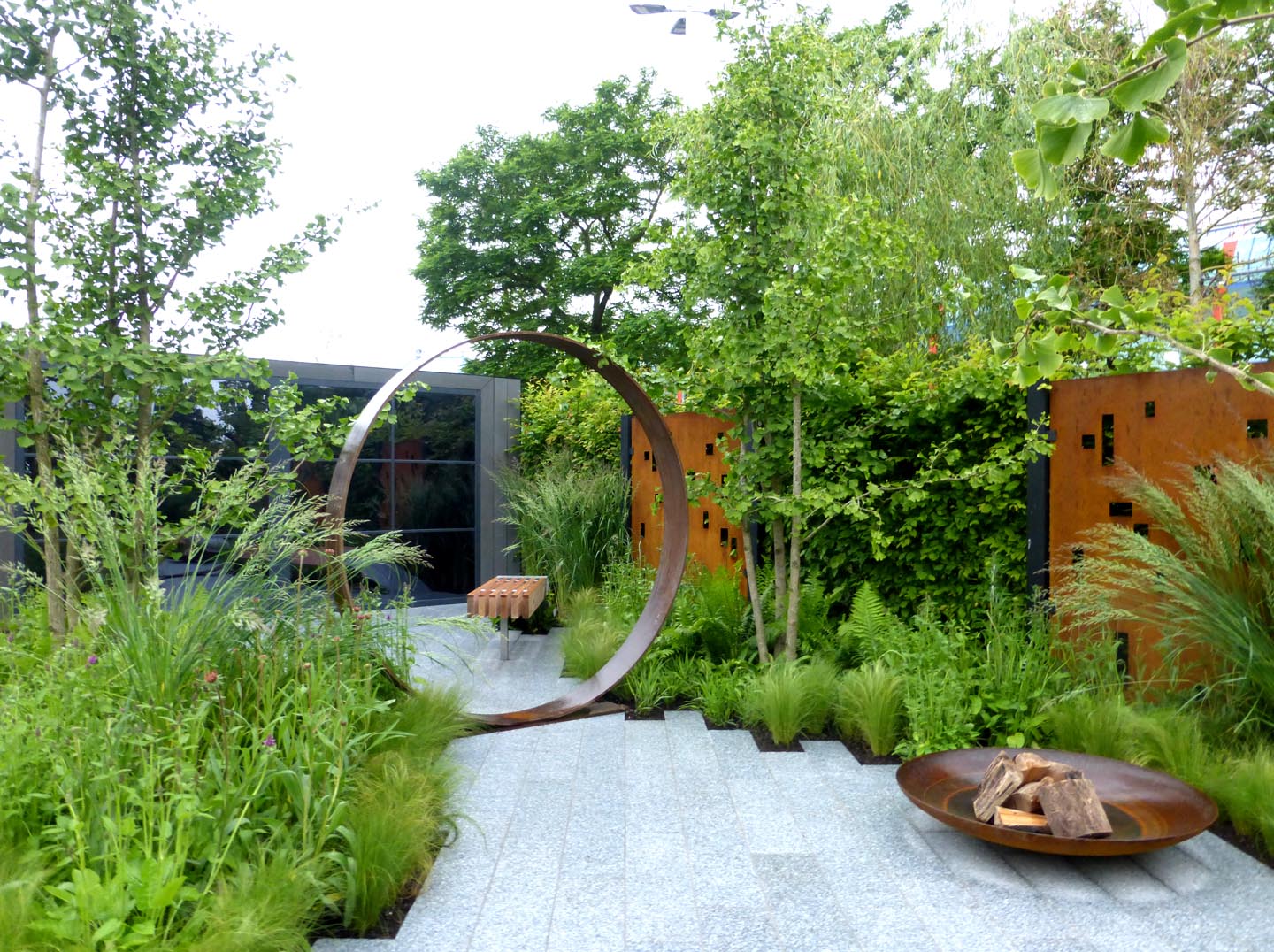
There's plenty to inspire visitors to the BBC Gardeners’ World Live show at the NEC in Birmingham. As well as the usual array of garden sundries, there's a series of imaginative and colourful floral displays and gardens in and around the Floral Pavilion. The show garden awards were announced on Thursday night, and two designers gained Platinum, the highest available: Alexandra Froggatt for her “Watchmakers Garden” (also named Best in Show, above) and Lucy Bravington, with Worcestershire-based landscapers DesignIt, for the “High Line Garden”. In her creation, Froggatt pays homage to the show’s host city, with the recreation of a garden typical of the back yard of a craftsman in the city’s historic Jewellery Quarter in the 19th c.
A lovely touch is the kitchen garden, crammed with heritage vegetables. It’s surrounded by cottage garden flowers, naturalistic grasses and rustic paths and fences.
Bravington’s Platinum design (above) was inspired by New York’s High Line – a beautiful garden on a bridge over a disused railway line. She’s mixed trees, perennials and ornamental grasses with industrial steel elements to create a sense of privacy. Gold awards went to Gadd Brothers in the APL Avenue for their “Getaway Garden” (designed for a young professional couple with a small linear garden), and Hana Leonard for “Here we go Round the Mulberry Bush” a garden with a circular theme that is sheltered by an airy tree.
Several of the gardens have an international flavour, among them “A Glimpse of South East Asia” by Timotay Landscapes (above). Filled with colourful tropical planting, it’s a fusion of ideas inspired by the natural landscapes of Indochina.  It features a shallow pebble pool which has beside it a large day bed and a hammock for chilling out (rather damp when I took this photo, but perfect for when the sun finally appears).
I loved the drama of the four horses charging out of the MS Society Revelation Garden, which won a silver merit, but if, in my dreams, I could chose a garden to take home, I’d go for another Gold show garden award winner, the John Lewis Home Solutions Garden created by Waitrose Partner Shaun Beale (below).
As well as mixing soft and sculptural planting, it has plenty of space for relaxing whatever the weather, with a garden office, water feature, and an eyecatching espaliered hedge for privacy.

BBC Gardeners’ World Live runs until Sunday, June 16 at the NEC, Birmingham.

Sunday, 19 May 2019

FOOD: Bigger than the Plate


Supernatural, by Uli Westphal, highlights packaging images that idealise ideas about food production.
The V&A has gone back to its roots – literally – with this latest exhibition. The museum is built on the site of the Brompton Park Nursery, founded in 1689 and once an important growing centre for fruit trees. Today, the future of our food, and our planet, is a matter of concern for everyone and the display takes a witty and sometimes provocative look at production ideas and alternative food futures.
The opening section, Compost, aims to change our perception of waste. One of the first things you see is Loowatt’s waterless flush toilet that collects excrement to be converted into fertilizer or to generate energy. Nearby, the problem of what to do with used coffee grounds is addressed by GroCycle’s Urban Mushroom Farm installation, which uses them to grow edible Oyster mushrooms, which will be harvested and go to the V&A’s Benugo cafe, to be used in selected dishes.
Farming explores how new technologies might change the way we grow and farm the plants and animals we eat. One idea is this Bicitractor L'Aggrozouk, designed for small-scale farming and which, being pedal-powered, has minimal impact on the environment.
Trading looks at the buying, selling and transporting of food. It questions the images sometimes used to make food look desirable (top) and asks visitors to think about their last meal. How did the food get from field to plate? A highlight here is the bar provided by Company Drinks, a community enterprise in east London that, inspired by the local tradition of hop picking, brings people together to pick, process and produce drinks. More than 36,000 people have so far been involved in the enterprise. The cordial I tried was a refreshing infusion of kale, rosemary, lavender, lemon balm, sugar and water, served in a paper cup.
The final section, Eating, is understandably the largest, exploring how a meal connects us culturally, socially and politically. It looks at the role of the table, the challenges we face in feeding the world, and the scientific projects, ingredients and recipes that push the boundaries of ingenuity in cooking. You can visit the pop-up food bar provided by the Centre for Genomic Gastronomy's LOCI Food Lab that makes tiny canapés to order once visitors choose three of their food priorities from a 15-strong list. My choice of a “delicious, affordable and protein-rich” canapé contained Essex chia seeds, British yellow peas and quinoa, mould microprotein and dried and powdered anchovy. The end result, below, certainly tickled the tastebuds.
The headline-grabbing feature in this section is the display of cheeses created from microbes harvested from the bodies of celebrities. You can't taste these – and quite honestly, I wouldn’t rush to try a Comté cheese created with the help of samples from Heston Blumenthal’s nostrils and pubic hair – but maybe in the future, we’ll be grateful for such delicacies. Anyhow, top marks to the V&A for addressing issues that affect us all with such engaging and thought-provoking installations. The show’s co-curators, Catherine Flood and May Rosenthal Sloan, point out that food is one of the most powerful tools through which we shape the world we live in. They say that now is a crucial moment to ask not just what will we be eating tomorrow, but what kind of food future do we want?
FOOD: Bigger than the Plate is at the V&A Museum in South Kensington until October 20, 2019. Tickets £17, concessions available.
https://www.vam.ac.uk/exhibitions/food-bigger-than-the-plate

Saturday, 18 May 2019

Stanley Kubrick: The Exhibition

Kubrick on set of 2001: A Space Odyssey © Warner Bros Entertainment Inc
It’s 20 years since the death of Stanley Kubrick, one of the greatest filmmakers of the 20th century and London’s Design Museum is celebrating his achievements with a major exhibition that explores his unique command of the whole creative design process of film-making, from story teller to director and editor.

Kubrick and Jack Nicholson on set of The Shining ©Warner Bros Entertainment Inc

He was known as a perfectionist, and wanted to control every aspect of his productions. This is evident at the very start of the exhibition, where the preparations for his Napoleon project, a film that never got made because of the cost, are recorded. During his research he logged every day in the emperor’s life, creating a card catalogue of the places and deeds of Napoleon’s inner circle. You also see it displayed in the meticulous way he recreated in the studios the facade of the Oregon Hotel for The Shining, and his comments on proposals for posters advertising that film, including: “I don’t like the dots for the logo. It will not look good small.”

Dr Strangelove - The Conference Table in the War Room ©Sony/Columbia Picture Industries Inc
In all, there are some 700 artefacts including props, photos, storyboards, and even cameras and lenses, with notes on which films they were used for. Each of his major films has its own section.

A Clockwork Orange Malcolm McDowell in the Korova Milkbar ©Warner Bros Entertainment Inc
It’s a trip down memory lane. A Clockwork Orange, Barry Lyndon, Dr Strangelove, Spartacus, Lolita, The Shining, Eyes Wide Shut, Paths of Glory, Full Metal Jacket and, of course, 2001: A Space Odyssey are all there, with pivotal segments shown in mini-cinemas (with very welcome seats). It all makes for a detailed and rewarding exhibition, and is a fitting tribute to Kubrick's genius. You'll find it hard to tear yourself away.
2001: A Space Odyssey still image ©Warner Bros Entertainment Inc
Stanley Kubrick: The Exhibition. At the Design Museum, 224-238 Kensington High St, London W86AG to Sept 15 2019. Admission £16 (concessions available).