Translate

Monday, 5 June 2017

Behind the garden wall at Lambeth Palace


The private garden of Lambeth Palace – the official London residence of the Archbishop of Canterbury –  is open to the public on the first Friday of the month until September. It’s been continuously cultivated since the 12th c, longer than any other in the country and various incumbents have put their own stamp on it.
The Palace is behind a high brick wall that runs along the Embankment. One of the first things you see on entering the courtyard is an enormous fig tree to the left of the entrance to the Great Hall. A White Marseilles variety, it was brought from Italy by Cardinal Pole when he arrived to become Queen Mary’s Archbishop in 1556. It still gives two crops of fruit a year, in July and October. The tree has also returned to Italy. In 2014, Archbishop Justin Welby visited Pope Francis in Rome and gave him a cutting from the tree as a symbol of the common heritage of the two religions.
The garden covers 10 acres and includes a terrace, Jewel Border, Rose Arbour, herb garden, bee hives, composting area and many mature trees. Among them is a Tulip Tree, a species introduced to England by Royal gardener John Tradescant the younger, and which was in flower in early June.
Fittingly, Tradescant is buried next door in the churchyard of St Mary-at-Lambeth, now the Garden Museum and recently reopened after a major refurbishment.
Open day visitors can go on a short guided walk around the Palace garden and learn more of  its  history and of future plans. These include a new purpose-built library and archive which will provide a climate-controlled home for the Palace’s collection of 200,000 precious books and 4,600 manuscripts, some of which go back to the 9th c. It will be at the far end of the garden, surrounded by a new garden designed by Dan Pearson.
Some of the historic books can be seen in the Great Hall, which was open at the same time as the garden. It’s been recently refurbished - a stunning new black and white marble floor has been laid and the lantern in the elaborate hammer beam roof  repaired. We were also able to look into the Crypt Chapel, described by the architectural hsitorian Nicholas Pevsner as one of the best preserved medieval stone vaults in London.
Allow at least two to three hours for this fascinating visit. Admission to the garden is £5, and refreshments are available in a marquee on the lawn.
http://www.archbishopofcanterbury.org/pages/visit-the-lambeth-palace-gardens-.html

Sunday, 30 April 2017

Bluebells in Perivale’s secret wood


A short walk from Perivale underground station in west London is a wood so precious it’s open to the public just once a year, when the forest floor is carpeted with more than four million bluebells.
Perivale Wood covers 27 acres of ancient oak forest and meadow, a remnant of the forest that once covered all of southern England. It was one of the UK's first nature reserves and is owned and managed by the Selborne Society, founded in 1885 to commemorate the 18th c. naturalist Gilbert White. In 1957 it was registered as a site of Special Scientific Interest and the Society began an intensive management programme to restore its fragile habitat, which had suffered from neglect during and after World War II.
Today there are signs of coppicing on the larger trees, and a programme of planned felling is creating clearings where seedlings have a chance to develop and rejuvenate the forest. The first Open Day was held in 1970, initially in May, but now on the last Sunday in April as global warming means the bluebells are flowering earlier. (Even so, the carpet of blue was almost past its best this year, and some visitors were suggesting the Open Day should perhaps be brought further forward.)
On the Open Day, a nature trail takes visitors along a specific route past the wood’s highlights and special displays. I loved this Bug Hotel made from recycled materials that provides shelter for wasps, bees, spiders, ladybirds and woodlice.
As well as the bluebells, there are banks of wild flowers, three ponds, two streams and glimpses of the Grand Union Canal that runs along part of the wood’s border. The reserve is also home to 24 species of trees, some carefully marked on the trail map. More than 100 species of birds have also been seen there, but maybe the sudden influx of people on Open Day sent them into hiding - on our walk round the wood, we heard just one crow.

Monday, 24 April 2017

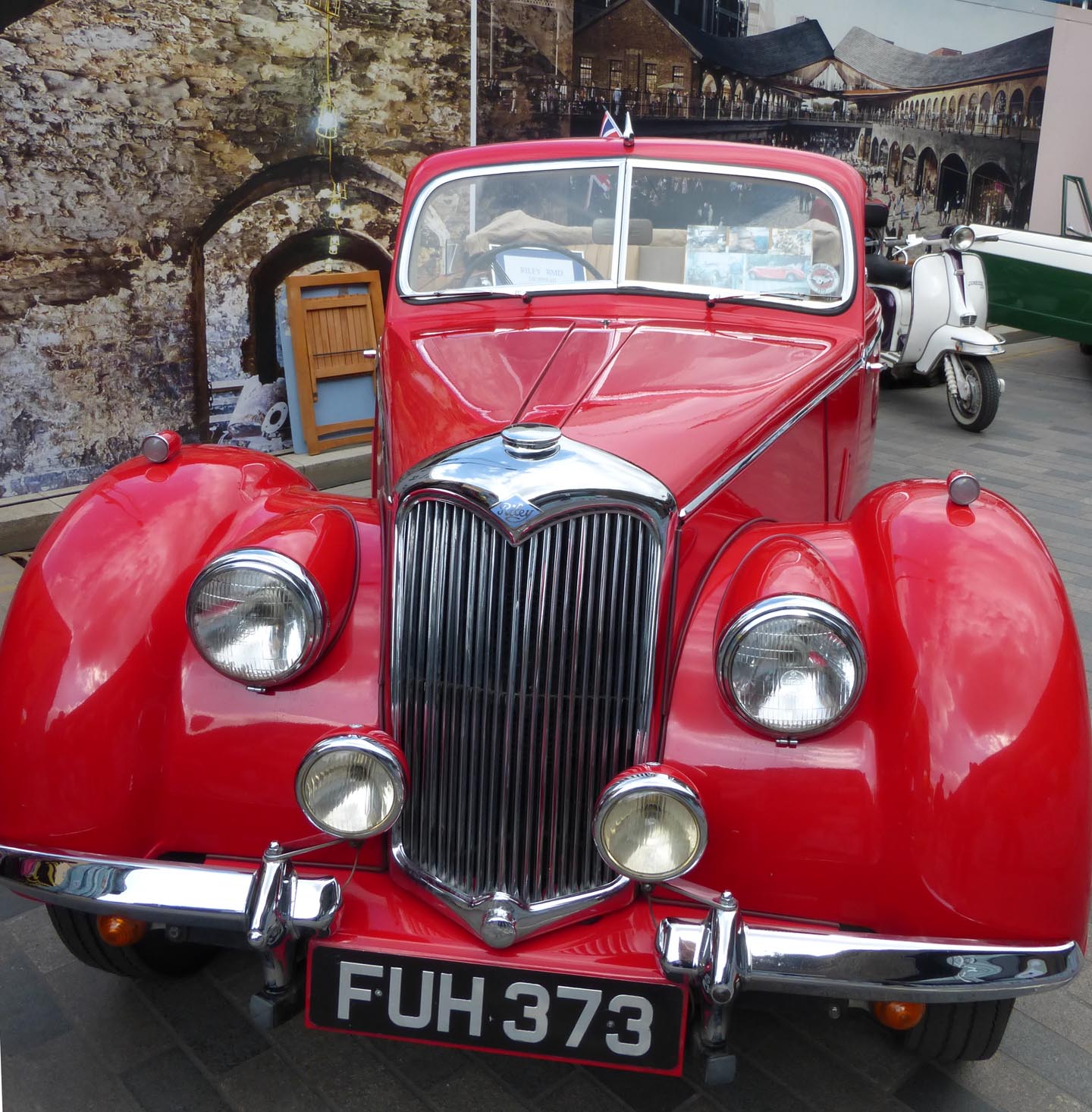
Classic cars and vintage buys


Some amazing sights at the Classic Car Boot Sale at Kings Cross in London at the weekend. Gleaming cars from yesteryear and so many household knickknacks that once might have been discarded, but are now collectors’ items.
Great to catch up with writer and craft expert Mary Jane Baxter, who was selling an assortment of goodies from her delightfully decorated Mobile Makery, including some vintage French posters she’d picked up on her travels through Europe. There was so much to tempt the crowds from the many stalls. But the stars of the show were the cars. No need to go to Cuba for a dose of motoring nostalgia!

Friday, 14 April 2017

Royal Greenwich Tall Ships Festival 2017


Spectacular sights on the Thames this weekend between Deptford and Woolwich Arsenal, with some 30 tall-masted ships from around the world taking part in this festival of sail. Many are moored at Woolwich, including the Nao Victoria (below, centre), an exact copy of the first ship to sail around the world in 1522 as part of Magellan's expedition.
Visitors can book on select vessels for a cruise from Woolwich that takes you under the Emirates Airline cable car....
.......and through the Thames Barrier.
There are also free visits to ships anchored in the river, and great views from the riverside walk as these reminders of yesteryear glide past, sails billowing.
Landlubbers have not been forgotten.
Family entertainment with plenty of food and drink has been laid on in the Festival Villages at Greenwich and the Royal Arsenal Dockyard. You may spot characters from the past.....
...or even a mermaid!
On Saturday evening a spectacular show of fireworks will light up the night sky at Woolwich. The festival culminates in a dramatic finale on Sunday - a Parade of Sail, with all the ships mustering on the river around Deptford/Greenwich before setting sail at 5pm, and heading off to Portugal.
http://www.royalgreenwich.gov.uk/tallships2017

Sunday, 2 April 2017

Battle of Medway Commemorations, June 8 – 17, 2017


Battle of the Medway. Credit: Kevin Clarkson

It’s being billed as 'the greatest of forgotten battles': in 1667 the Dutch launched a daring raid on the Medway river in Kent, navigating treacherous shoals and currents to attack Royal Navy ships in  what had been regarded as a safe anchorage off Chatham. They burnt 13 vessels and towed away two more, including the flagship, the Royal Charles. It was the culmination of a series of tit-for-tat skirmishes and a crippling blow for the Royal Navy, already in a bad way because of lack of money. It led Charles II to agree to a quick end to the Second Anglo-Dutch War and a favourable peace for the Dutch.
The 350th anniversary of the battle is being marked by Medway Council with a 10-day programme of events, including exhibitions, sporting events and a concert and culminating in a river-based finale (artist's impression, above), Medway in Flames. This will retell the battle through big screens, digital projection, and fireworks.
The backdrop to the event will be Upnor Castle, where you can still find guns used in the battle. A further big attraction will be two fleets, including some tall ships, that will be coming over from the Netherlands - the first on June 8 and the second on June 14 - to take part in the commemorations.
The mastermind behind this new Dutch invasion is Frits de Ruyter de Wildt (above), a direct descendant of the man who commanded the assault, Lieutenant-Admiral Michiel de Ruyter. During a  reconnaissance visit to Upnor Castle, he said that while his ancestor was known as the Great Terror of the Seas, this fleet would be coming not in fire, but in friendship. In fact, the raid was actually a blessing in disguise for England – it led to the complete rebuilding and reorganisation of the Royal Navy, with huge investment in new ships and dockyards. Much of this is still evident at the Historic Dockyard Chatham (below), which will be playing a major part in the festival.
The rebuilding of the navy laid the foundation of British supremacy at sea for the next 200 years and contributed to Britain’s economic success and the growth of the empire. So rather than commemorating a defeat, Medway in Flames will be celebrating the centuries of friendship and trade between the two countries. After all, in 1689, just twenty-two years after battle, the Netherland's William of Orange and his wife, Mary, were invited to become rulers of England.