Translate

Showing posts with label Greenwich. Show all posts

Sunday, 3 September 2017

Charlton House - a Jacobean gem


The Royal Borough of Greenwich is best known for its naval connections and of being the home of Greenwich Mean Time. But less than two miles to the east is a little-known gem: Charlton House, one of the finest surviving Jacobean manor houses in England. It sits on a hill, and when construction began in 1607, the estate stretched right down to the river. The diarist, John Evelyn, described the view as ‘one of the most noble in the world, for city, river, ships, meadows, hills, woods and all other amenities’. Today it's surrounded by urban sprawl. The house, however, retains many of its original features. It was built for Sir Adam Newton, tutor to James I’s son Henry, older brother of Charles 1. He sadly died at the age of 18 but the royal connection features in several places, including the Prince of Wales feathers above the east door to the Minstrel Hall, where you enter.
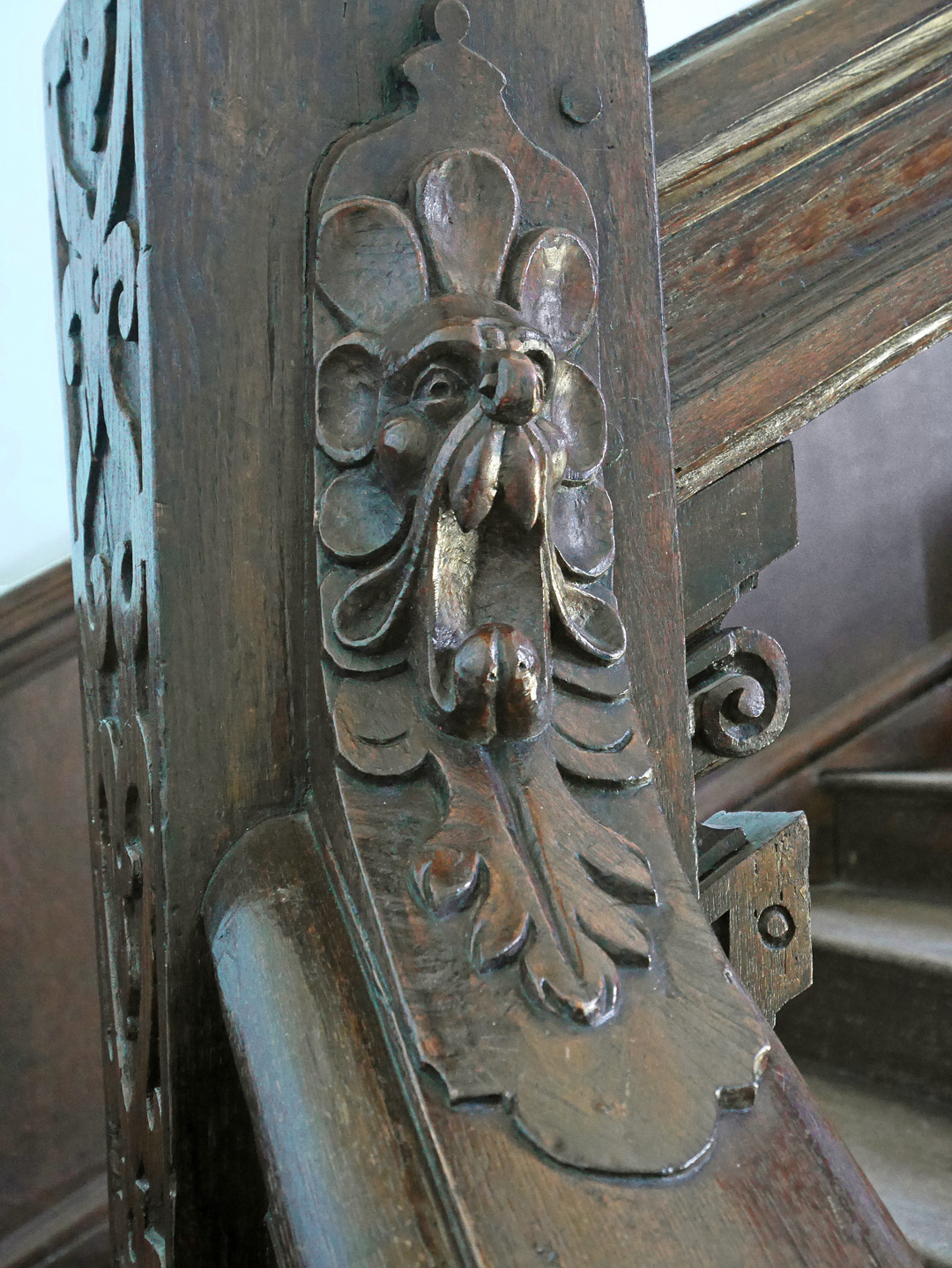
 Leading off this is the Grand Staircase, where the decoration becomes more ornate as you ascend. It was believed evil spirits grew more dangerous the higher you were, so carved into the banisters are grotesque faces whose mouths grow bigger as you ascend – all the better to devour them.
On the first floor the Long Gallery, designed to provide space for exercise in bad weather, is unusual in that it stretches from front to back, rather than sideways.
Next to it is the Grand Salon, recently used as a set for a film about the Getty family.
Ceilings have elaborate plaster-work, and the numerous fireplaces are decorated with beautiful tiling.
On the ground floor, each of the doorways to the Chapel and Wilson room (now a public library) bear panels with crests. The house is thought to have been designed by John Thorpe, one of the earliest known British architects, who lived c 1560 – 1620. It passed through several owners, and between 1767 and 1923 was owned by the Maryon-Wilson family, who added the Old Library with its striking ceiling (below) and the Minstrel Gallery in the entrance hall (now a tea room).
They also enclosed the village green at the front of the house, which is why the original gateway, with its elaborate decoration (below), now stands apparently stranded in the middle of the front lawn.
During World War I the house was used as a hospital for officers, and in 1925 was bought by Greenwich Council. The building’s front was damaged in WWII when a German V2 rocket struck in the garden.
Among the interior casualties was this statue of Vulcan, on the Grand Salon fireplace, who lost some toes, and the plaster work ceiling in the Long Gallery. This was recast using the original moulds that had been stored in the basement; the facade was rebuilt with non-matching bricks (all that were available in wartime). Today Charlton House is cared for by the Royal Greenwich Heritage Trust.
In the grounds you will find Jacobean stables, an Amnesty International Peace Garden (above), and a magnificent gnarled mulberry tree, said to have been ordered by King James I to encourage the establishment of a silk industry in England. (Unfortunately it never took off, as the trees he procured were black mulberries, while the silkworms feed on white.)
It still produces fruit, which is used in the cafe’s seasonal desserts. There’s also a Summer House, originally a banqueting house.
This was built in 1630 and attributed to Inigo Jones, who designed the nearby Queen’s House in Greenwich. After having been converted to public toilets, it was closed in the early 90’s. Restoration is now underway, thanks to a donation from the World Monuments Fund. Once the first stage of this is completed, it will become home to temporary exhibitions and events - yet another reason to visit Charlton House.
Entrance to the house and grounds is free.
https://www.greenwichheritage.org/visit/charlton-house

Friday, 14 April 2017

Royal Greenwich Tall Ships Festival 2017


Spectacular sights on the Thames this weekend between Deptford and Woolwich Arsenal, with some 30 tall-masted ships from around the world taking part in this festival of sail. Many are moored at Woolwich, including the Nao Victoria (below, centre), an exact copy of the first ship to sail around the world in 1522 as part of Magellan's expedition.
Visitors can book on select vessels for a cruise from Woolwich that takes you under the Emirates Airline cable car....
.......and through the Thames Barrier.
There are also free visits to ships anchored in the river, and great views from the riverside walk as these reminders of yesteryear glide past, sails billowing.
Landlubbers have not been forgotten.
Family entertainment with plenty of food and drink has been laid on in the Festival Villages at Greenwich and the Royal Arsenal Dockyard. You may spot characters from the past.....
...or even a mermaid!
On Saturday evening a spectacular show of fireworks will light up the night sky at Woolwich. The festival culminates in a dramatic finale on Sunday - a Parade of Sail, with all the ships mustering on the river around Deptford/Greenwich before setting sail at 5pm, and heading off to Portugal.
http://www.royalgreenwich.gov.uk/tallships2017

Wednesday, 16 November 2016

The Queen's House, Greenwich, reopens

The Queen’s House, the beautiful 17th century villa in Greenwich designed for Anne of Denmark, is celebrating its 400th anniversary after a major refurbishment. It’s just reopened after 14 months and has new displays, lighting and colour schemes. The Palladian building was the work of the celebrated British architect, Inigo Jones. When he won the commission, he had recently returned from Italy and his plans reflected this: the first fully Classical building seen in England, its elegant white facade and double-height Great Hall were a far cry from the red brick warren of the neighbouring Tudor palace (now demolished).
Sadly Anne, the wife of James 1, never saw her mansion finished, though her portrait (above) hangs on the wall. She became ill not long after construction began and died in 1619. It was completed for Charles I’s wife, Henrietta Maria, but the Civil War that followed saw it stripped of much of its decoration and paintings. Members of the royal family visited occasionally after the Restoration but it never regained its former glory.  Succeeding years saw it serve many purposes, including that of a home for the Park Ranger and later the Greenwich Hospital School. In 1937 it was reclaimed to house the art collection of the National Maritime Museum, with paintings by artists such as Canaletto, Hogarth, Lowry, Stubbs and Reynolds.
One of the most striking features of the refurbishment is the delicate gold leaf decoration by Turner prize-winner Richard Wright, scattered over the ceiling the Great Hall. Although modern, it’s a perfect complement to the airy space with its striking marble floor, while subtly echoing the gilt elsewhere in the house.
You pass from the upper gallery into two lavishly decorated rooms - the Presence Chambers of the King (above) and the Queen. These now have bright new colour on the walls and gold highlights the elaborately carved ceilings. A welcome touch - the elegant chairs that allow you to sit in comfort and study the portraits of royalty and courtiers, among them the famous Armada portrait of Elizabeth I, who was born at Greenwich.
Once owned by Sir Francis Drake, this became part of the national collection in July 2016 after a public fundraising campaign that attracted thousands of individual donations.
Also on display are treasures of the Royal Museums Greenwich art collection, many historic paintings of the area and new contemporary art with a nautical theme.
The refurbishment has also seen a restoration of the spectacular Tulip stairs, the earliest unsupported spiral staircase in England.
Despite the name Tulip, the floral design on the wrought-iron rails is probably of lilies, the royal flower of France, in honour of Henrietta Maria. The Queen's House has enough to keep a visitor happy for a good hour or two (there are some amazing treasures displayed in tiny cabinet rooms at the back of the house) and with the Maritime Museum, the Cutty Sark and Old Naval College (below) so close, it makes for a fascinating day out.
The Queen’s House is open every day 1000 – 1700. Admission free