Translate

Showing posts with label London. Show all posts

Monday, 23 March 2015

The Shard or the Sky Garden?


There was a huge buzz when the View from the Shard opened just over two years ago. At the top of the tallest building in Western Europe, it was the place to go for proposals, birthdays, and other special occasions or just for a never-before-seen view of London.
One year on, it’s still a major tourist attraction, an iconic addition to the capital’s skyline. But across the river there’s a rival - a new skyscraper also offering spectacular views of landmarks, including the Shard (left).


The Sky Garden, on top of the Walkie Talkie (aka 20 Fenchurch St), doesn’t take you up so high, but the panorama is still impressive (left). It also has London’s highest garden, places to sit and relax, restaurants and a bar.


So how do they compare?

Well, for a start, access to the Sky Garden is free (though you need to book in advance), while the View from the Shard costs £24.95 if you book in advance, or £29.95 on the day.

Height-wise, the Sky Garden is on the 35th floor, while the View from the Shard is on floors 69 to 72. So though looking down on London from the Sky Garden is amazing it can’t quite compete with the heart-stopping moment at the Shard, when you first see the City in miniature below you (left) and the curve of the horizon. The Tower of London, the boats on the river and the trains going into London Bridge Station look like children’s toys. Birds soar and sometimes a helicopter will buzz past.  


The Shard's viewing galleries (left) are just that, viewing galleries - the restaurants on the lower floors operate separately - but to add to the experience, they have inter-active touch-screen telescopes which can zoom in on landmarks and tell you more about them.


The Sky Garden (left) is more of a social space – a place to linger. The open-air terrace, which faces south, and the two observation decks together offer 360’ views. 


When you’ve had enough of these, there is the garden to admire (below), sheltered under a glass dome and given a tropical atmosphere with plants mostly from Brazil, South Africa and New Zealand.


The restaurants offer everything from a coffee and croissant  to a meal. There's a range of prices: Venison Pie, £18 and Tuna Nicoise £13 at the Darwin Brasserie; Dressed Crab £22 and Whole Dover Sole £42 at the Seafood Bar and Grill.

Perhaps because of the relaxed atmosphere, we could find no information there about what you can see – either the view or the plants - so taking a map to orientate yourself is a good idea.


So which should you visit?

For a real bird’s-eye view of London, and if you aren’t afraid of heights, try a trip up the Shard. It's a memorable occasion, and the admission price is not too far out of line with that for other premium attractions now. You will also learn about its construction and the fox that tried living the high life on its upper reaches.


Sky Garden is a gentler, though still amazing experience, and being free, a place to which you could return time after time, to meet friends for a bite or just to enjoy the ever-changing panorama (above). With both you get a feel for London's geography and the surprising quirks of some of its buildings - impossible to grasp at ground level. And both let you see familiar landmarks from a new perspective: looking down on the Monument (just around the corner from the Sky Garden), we watched visitors emerging from below the golden flame to be confronted by a huge crane working on an adjacent building site.
Two tips:
If you’re keen on photography, a selfie-stick would be useful at both venues. The open-air viewing platforms are protected by substantial glass walls, so a camera needs to be up high to avoid reflections. And if you can, check the weather forecast before you book. Pollution made viewing difficult the day we visited the Sky Garden, though there was still plenty to enjoy. Because of its height, the Shard is sometimes wreathed in cloud and if you can’t see at least three landmarks, including the London Eye, St Paul’s Cathedral, The Gherkin, Tower Bridge and the Canary Wharf Tower. you are promised a free return ticket, valid for three months, Fine if you live somewhere close, but perhaps not so good for tourists with limited time.

www.skygarden.london
www.theviewfromtheshard.com

For more on the Shard and other 'top' sites in London, see
http://greenjottings.blogspot.co.uk/2013/01/the-view-from-shard-and-some.html

Monday, 16 March 2015

Inventing Impressionism


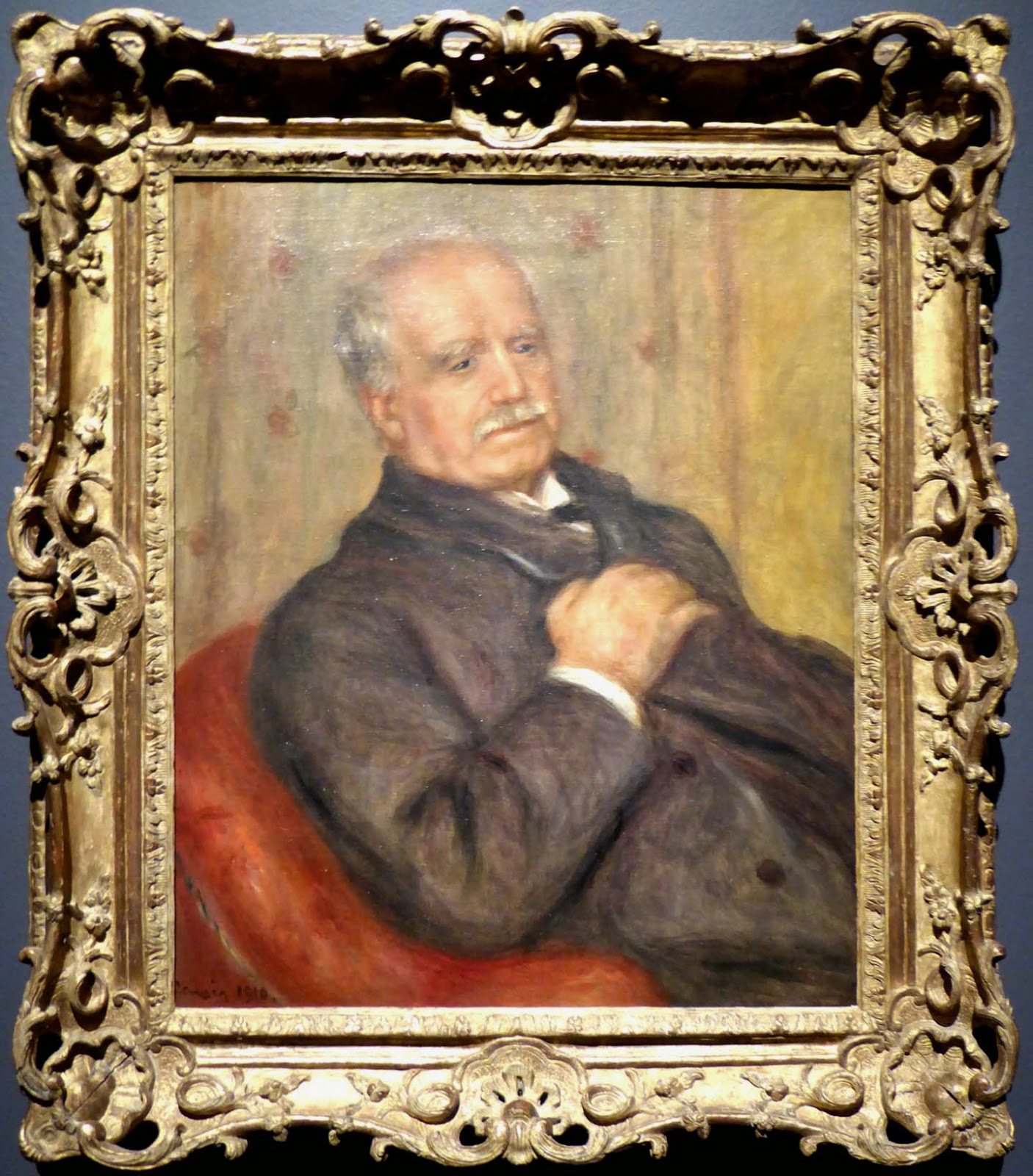
Impressionism is one of painting’s best-loved movements, yet if it hadn’t been for one man, Paul Durand-Ruel (left), it might never have existed. He is the art dealer described by this new exhibition at London's National Gallery as “The man who sold a thousand Monets”. But it’s also a story of hardship and courage.


Durand-Ruel  took over his father’s Paris art-dealing business in 1865, and had a passion for what he called the “beautiful school of 1830” – paintings by Corot, Rousseau, Millet and Courbet. When France declared war on Prussia in 1870, he moved to London and opened a gallery on New Bond Street. There he met two young painters also taking refuge in the city: Claude Monet and Camille Pissarro. He immediately began to buy and exhibit their pictures, even though his enthusiasm was not widely shared. Monet’s The Thames below Westminster was among them.
Back in Paris, he continued to invest heavily in what would soon be referred to as the “new painting”, and bought pictures from other members of the future Impressionist circle, paying them monthly salaries against future work, sometimes settling their bills and always giving them moral support.  “Without him,” said Monet later, “we wouldn’t have survived.”
But the public wasn’t buying. After one exhibition Durand-Ruel staged in 1876, a critic wrote: “There are people who burst into laughter in front of these objects. Personally I am saddened by them.”
 Several times the dealer was on the brink of ruin. But still he persevered, hanging the paintings in his own house in the rue de Rome and inviting people there on Tuesdays, when the main galleries were closed, to show how the new art complemented a traditional decor. Renoir was a favourite, and the exhibition opens with a recreation of the family’s Grand Salon, complete with his portraits of them, including Durand-Ruel's daughters (left).


The dealer tried new markets, opening galleries in New York and Brussels, assisted by his sons, and pioneered solo exhibitions.  One featured Monet’s Poplars series, five of which are reunited at the National Gallery exhibition
.

It was in fact America that proved his financial salvation. Among his Paris artists was Mary Cassatt, whose Child’s Bath is included in the exhibition. She came from a wealthy family - her brother was an American railroad magnate – and she used her influence to help arrange an Impressionists exhibition of 300 paintings in New York. It was a major success. “The Americans do not laugh, they buy,” said Durand-Ruel. Gradually, progressive collectors in Europe followed suit.


1905 saw the dealer again try to crack the London market with a major exhibition of 315 works at the Grafton Galleries (left). Crowds flocked to see it and there was widespread critical interest.


The final room of the exhibition (left) gives an idea of how it looked. But just 13 paintings were sold, some to an Irish collector, Hugh Lane. When the Sunday Times wanted to raise a subscription to buy a Monet for the National Gallery, the trustees weren’t interested. However ten years later, when Lane died (he was on board the liner Lusitania when it was torpedoed by a U-boat) they were taken aback to find that according to his will, they now owned the paintings they had earlier rejected. Today, these form the nucleus of the nation’s collection of modern paintings.  
Durand-Ruel died in 1922, by which time the paintings he championed were in galleries around the world. Towards the end of his life, he declared: “My madness had been wisdom. To think that, had I passed away at sixty, I would have died debt-ridden and bankrupt, surrounded by a wealth of underrated treasures....”

Inventing Impressionism is at the National Gallery's Sainsbury Wing until May 31 2015
Admission £18 (concessions available).
www.nationalgallery.org.uk


Sunday, 22 February 2015

Hodge - a very fine cat indeed


It’s not often you see a statue of a cat, which is what made me pause in Gough Square, just off London’s Fleet St, the other day. On a plinth was a slightly grumpy-looking feline, cast in bronze and sitting on a large book. Beside it were some empty oyster shells.  The cat, of course, is Hodge, the indulged companion of the 18th c writer Samuel Johnson, whose house (below) on the opposite side of the square is now a museum, and the book is the famous dictionary Johnson compiled.
 Hodge was remembered  by James Boswell in his biography of Johnson: 'I recollect him one day scrambling up Dr Johnson’s breast, apparently with much satisfaction, while my friend smiling and half-whistling, rubbed down his back, and pulled him by the tail; and when I observed he was a fine cat, saying, “Why yes, Sir, but I have had cats whom I liked better than this;” and then perceiving Hodge to be out of countenance, adding, “but he is a very fine cat, a very fine cat indeed.” '
 Although oysters are today an expensive delicacy, in the 18th c they were cheap and a staple food of the poor.  Boswell recalled that Dr Johnson used to go out and buy oysters for his cat “lest the servants having that trouble should take a dislike to the poor creature.”
It seems Hodge was black. When he  died, his life was celebrated in ‘An Elegy on the Death of Dr Johnson’s Favourite Cat’ by Percival Stockdale, published in 1778, which describes his fur as ‘sable’: "Who, by his master when caressed, warmly his gratitude expressed, and never failed his thanks to purr, whene'er he stroked his sable fur."
The statue is by sculptor Jon Bickley and was installed in 1997. It was modelled on his own cat, Thomas Henry.