Translate

Monday, 31 August 2015

Venice's Festival of the Redeemer


Venice is famous for its carnival and festivals, but the oldest continually celebrated date in the Venetian calendar is the Festa del Redentore - the Feast of the Holy Redeemer - held annually on the third weekend of July.
The festival began in the 16th century, to mark the end of the terrible plague of 1576, which killed 50,000 people, including the great painter Titian. As a gesture of thanksgiving, the Doge commissioned the architect Palladio to build a church on the Giudecca island. It was consecrated in 1692 and so that the Doge could walk there in procession, a temporary bridge across the canal was made of barges. 


This bridge-building tradition continues today. For several days before the festival, the pontoons are moved into place, and by Friday (above), thousands of people are able to stream across it to the church.
At the same time, hundreds of little craft, often decorated, make their way along the Giudecca canal. By dusk, it is packed with vessels of all kinds, their occupants feasting and celebrating. You can barely glimpse the water between them.
Revellers without a boat pack the rooftops, balconies and pavements overlooking the canal – many enjoying elaborate banquets laid out on picnic tables. Everyone is in holiday mood.
At 2330 comes the moment everyone has been waiting for: fireworks, set off from nearby pontoons, light up the sky. This year they continued for 45 spectacular minutes.
As the boats begin to depart,  many people end their evening by going to the Lido, where they sit on the sand and wait for the dawn. For everyone, it's magical end to an unforgettable occasion.

Thursday, 25 June 2015

A tropical retreat on London's Oxford Street


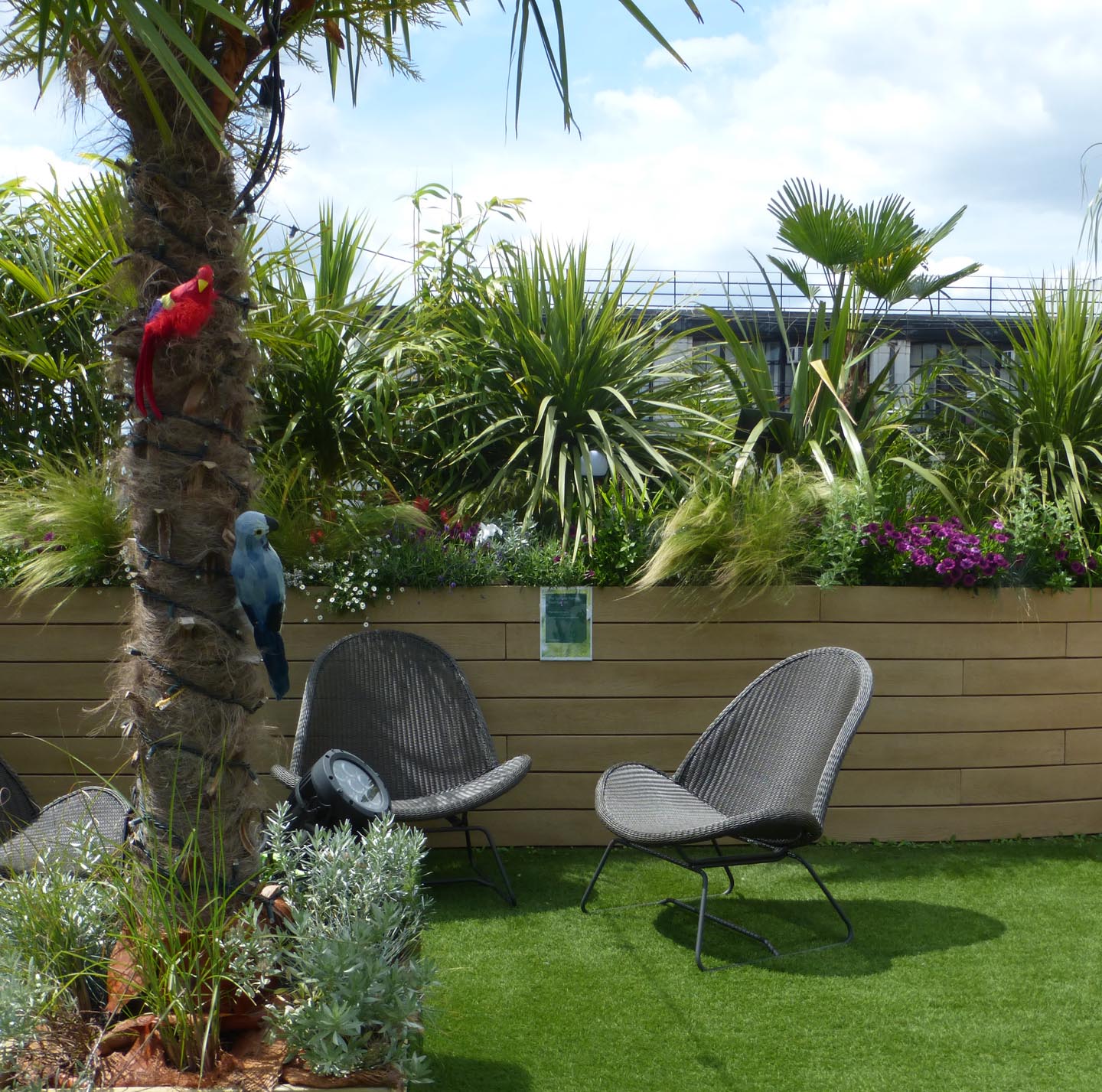
For the second year running, John Lewis has created a public garden on the roof terrace of its flagship Oxford Street store. Last year there were lots of cottage garden plants – this year’s ‘Summer Retreat’ has a distinctly Caribbean feel.
 The first thing you see as you walk out across the grass is a palm tree festooned with signs for Barbados, St Lucia, Jamaica and Tobago, and decorated with realistic-looking parrots.
No beach, but pieces of driftwood, brightly-coloured plants and strategically placed butterflies enhance the tropical mood.

  There are plenty of chairs for relaxing when the sun comes out, and a little balcony provides an unusual view of some London landmarks. Rossopomodoro and Joe and the Juice serve ice cream, Italian food, sandwiches and juices and should you fancy some retail therapy, there are a couple of pop-up shops in beach huts. It’s a great place to escape to - a real treat for shoppers in the know.
The garden is open from noon until close on Monday, Tuesday, Thursday - Sunday and on Wednesday from noon until 4pm. Access is by lift or stairs near the 5th floor restaurant. More details at http://www.johnlewis.com/findyoursummer/news-and-events


Sunday, 14 June 2015

Ten things you may not know about the Magna Carta


John was a tyrant, John was a tartar
John put his name to the great big charter
Every baron from Thames to Tweed
Followed the road to Runnymede.

(Hugh Chesterman, b. 1884) 


Runnymede is currently in the news with celebrations being held to remember the signing of the Magna Carta 800 years ago, on June 15. To mark this anniversary, the British Library has mounted a major exhibition, which includes two surviving copies, two of King John’s teeth – and many interesting facts: 


1. Despite common assumption, King John never signed the charter when he sat down with his Barons. Instead, he affixed his seal – the usual practice for kings at that time. 
2. The provisions in the document lasted just 10 weeks before it was annulled by the Pope, who declared it to be 'base and shameful, null and void".
3. It was revised by later monarchs and entered the statute books in 1297.
4. It was used to draft the 1628 Petition of Right, which limited the authority of Charles I, and was cited against him during his trial the following year. Since then, the law has slowly encroached on royal privilege, and today, no one in the UK is above the law, not even the Queen.
5. It influenced the wording of America’s Declaration of Independence and Bill of Rights.
6.The slices in the bottom of one of the copies on display at the British Library (below) are not, as urban legend tells, from King John’s knife, stabbed down in anger, but to hold the long-since-lost wax seal.
7.Four manuscripts of the 1215 Magna Carta survive today. One is owned by Lincoln Cathedral, one by Salisbury Cathedral, and two are with the British Library.
8.In 1941 the British Cabinet, seeking ways to persuade the US to enter the war, considered giving Lincoln Cathedral’s one to Washington as a gift.  But the plan foundered when it was realised the ‘bit of parchment, more than 700 years old’ was not theirs to give. 
9 Only three provisions remain in force today: the right of trial by jury, protection for the liberties of the City of London and other cities, boroughs, towns and ports, and the freedom of the Church of England.
10 The British Library occasionally gets letters from drivers asking if the Magna Carta protects their rights to appeal against parking tickets. It doesn't.


The exhibition runs until 1st September, 2015. Entry is £12.

Sunday, 31 May 2015

The London Loop – from High Barnet to Cockfosters


This weekend’s free Walk London Spring into Summer excursions saw us with a group of enthusiastic walkers making the trek across the top section of the London Loop – a 150-mile walking path around the outskirts of the capital. The three and a half mile ramble saw us passing woods, Georgian houses and the site of a 15th c battle.


We started at High Barnet Underground station, having been met by City of London guide Paul Baker, who lives locally. A short walk through suburbia took us to a wooden gate. Filing through, we found ourselves in a different world. King George’s Field, once part of a grand estate, is a public open space given in 1937 to commemorate King George V. It covers 28 hectares and is surrounded by hedgerows, woodland and small streams - a haven for birds and wildlife, and popular with dog-walkers.
A path led us uphill for about a quarter of an hour. Then, looking back, came our reward: a magnificent view of the city and Docklands with the North Downs on the horizon. The area adjoining this high point was the scene of a crucial struggle during the War of the Roses. The Battle of Barnet was fought here in early morning fog on 14 April 1471. It was a victory for the Yorkist forces of Edward IV, who had seized the throne from the Lancastrian king, Henry VI, but hundreds of men on both sides died, among them Warwick the Kingmaker. 

Our route then took us past Monken Hadley Green, with its row of beautiful Georgian houses. One (above) is named after the explorer David Livingstone. He stayed here in 1857/8 before returning to Africa. Other past residents in the area include the Victorian author Fanny Trollope and her more famous son, Anthony (Barchester Towers, The Way We Live Now) who moved there in the vain hope the more healthy air would help her daughter's TB.
Further along is Monkenhurst (above), a Victorian mansion bought and saved from demolition by the comedian, Spike Milligan. Father and son writers Kingsley and Martin Amis lived at nearby Lemmons, formerly Gladsmuir House, and the poet laureate Cecil Day Lewis died there during a visit in 1972.

Opposite is St Mary’s church, which dates from 1494. We didn’t have time to go in, but discovered another famous connection: it was painted by Turner while staying next door with some friends. (The picture is now in Tate Britain.) There's also a row of charming almshouses, founded in 1612 by Sir Roger Wilbraham for 'six decayed housekeepers'.
The last part of our walk took us along the south side of Monken Hadley Common. This was granted to parishioners for grazing livestock in compensation for the loss of their rights in the royal hunting forest of Enfield Chase after its enclosure in 1777.
Five pairs of white gates were installed to stop cattle straying (here at the south-east corner), but today, with the livestock gone, they are left permanently open and the common is a conservation area and popular recreation spot.


We crossed Pymmes Brook and reached the tranquil Jack’s Lake, named after a former landowner. Some anglers could be seen on the far side, and waterfowl were gliding across, enjoying the spring sunshine.


Another short walk through woods brought us to Cockfosters for a train home – our final treat being a glimpse of cricket on the sports grounds.
It was a fascinating afternoon, thanks to Paul's stream of facts and anecdotes - an introduction to a part of London we may never otherwise have seen. (He does other walks in the area too: http://www.barnetwalks.talktalk.net/walks.html)
Walk London’s three free weekends of walks – funded by Transport for London – take place in spring, autumn and winter. There are usually around 40 to chose from, varying from a couple of miles to more than eight.
 http://www.walklondon.org.uk/
In between, you can try the self-guided tours:
http://www.walklondon.com/